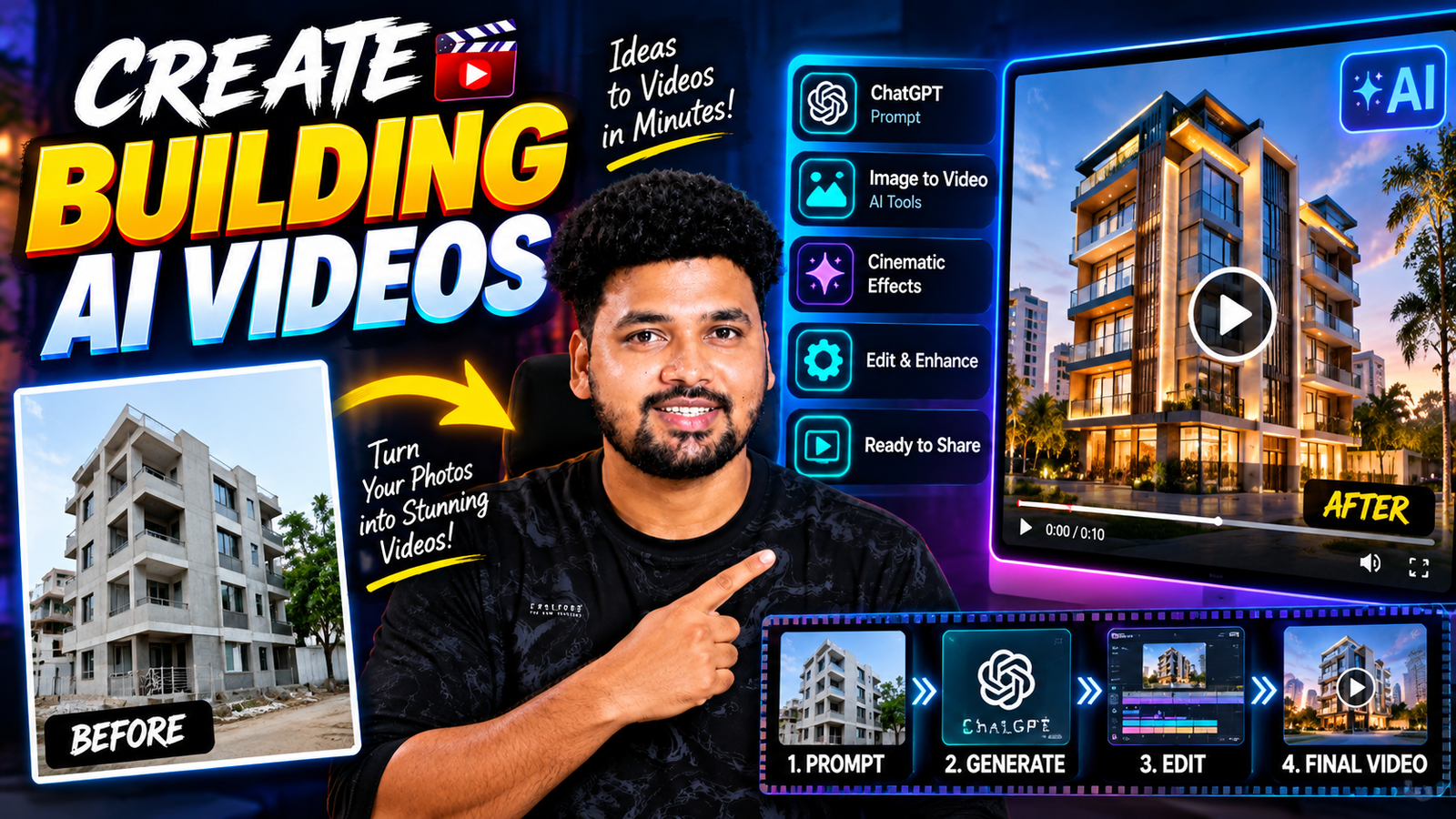
Image generation → Empty-site reconstruction → Image-to-video construction animation

A practical resource for turning a completed-building photograph into a cinematic AI construction/reveal video. The workflow uses the real building as the architectural target, creates a matching empty site, then animates the construction into the finished property.

1. Complete Workflow
- Upload a clear photo of the completed building. Treat this as the FINAL architectural reference.
- Generate a completely empty construction site matching the same location, camera angle, perspective, road, sidewalk, trees, neighboring buildings, sky and environmental context.
- Upload both images into an image-to-video model: FIRST FRAME = empty site, LAST FRAME = completed building.
- Use one construction animation prompt. The building should physically assemble instead of simply morphing between the two images.
- For a more dramatic result, use the Cinematic Construction or Gravity Build version.
2. IMAGE GENERATION PROMPT —
Create a hyper-realistic professional real-estate photograph of a premium modern Indian commercial or residential property, inspired by the uploaded architectural reference.

Preserve the core architectural identity of the reference while presenting it as a polished, professionally photographed completed property. Use contemporary Indian architecture with realistic construction materials, clean geometric forms, large glass windows, refined façade details, landscaped greenery, realistic roads and sidewalks, and believable surrounding urban context.

The building must look genuinely constructed, not like CGI. Include realistic material textures, subtle imperfections, accurate glass reflections, realistic window frames, doors, railings, façade joints, entrance details and landscaping.

Camera: professional architectural photography from street level or a slightly low angle, natural perspective, full building visible, vertical 9:16 composition.

Lighting: bright natural daylight with a clean neutral-white balance. Soft realistic shadows, natural blue sky and subtle clouds. Keep the image premium and cinematic but avoid an excessive orange or golden-hour cast.

Visual quality: ultra-photorealistic, professional real-estate photography, full-frame camera look, 28–35mm architectural lens, realistic depth, high dynamic range, physically accurate lighting, detailed materials, natural reflections and realistic environmental atmosphere.

Avoid: CGI appearance, cartoon styling, fantasy architecture, excessive HDR, oversaturation, strong orange color grading, distorted windows, warped geometry, unrealistic cars, fake vegetation, text, logos and watermarks.
3. IMAGE GENERATION PROMPT — EMPTY SITE
Create a hyper-realistic architectural photograph of the EXACT SAME LOCATION and property shown in the uploaded completed-building reference, but at the EARLIEST CONSTRUCTION STAGE.

The completed building must NOT exist yet.

Show a completely empty construction plot with a realistic poured-concrete foundation and footings matching the exact footprint, orientation, dimensions and stepped geometry of the final building. No walls, no windows, no balconies, no finished façade and no completed building structure.

CAMERA AND COMPOSITION:
Match the uploaded reference image's camera position, height, lens perspective, viewing angle, framing, horizon level and overall composition as closely as possible.

Preserve the same road, sidewalk, neighboring buildings, trees, landscaping context, sky and background perspective. The location must remain recognizable as the same property.

CONSTRUCTION STAGE:
Show realistic concrete footings, foundation slabs, trenches, reinforcement bars and exposed soil where appropriate. Keep the construction stage believable and physically consistent with the final building footprint.

LIGHTING:
Use natural neutral daylight with realistic shadows and a clean color balance. Avoid excessive warm/orange grading.

PHOTOREALISM:
Professional architectural photography, physically accurate materials, realistic concrete texture, subtle dirt and construction imperfections, natural atmospheric depth, realistic perspective and high detail.

CRITICAL:
The empty site must have the SAME camera perspective and environmental context as the final building image so it can be used as the first frame of an image-to-video construction transformation.

NEGATIVE PROMPT:
No completed building, no walls, no windows, no balconies, no façade, no finished structure, no incorrect footprint, no changed camera angle, no changed road, no changed neighboring buildings, no fantasy architecture, no CGI look, no cartoon appearance, no excessive orange color grading, no text, no logos, no watermark.
4. IMAGE-TO-VIDEO PROMPT —
# REFERENCE IMAGE DEFINITION

@image = The final destination frame of this video. It defines the exact form, material, lighting, overall color grading, target architecture, and surrounding area.

Any mention of “target,” “building,” or “zone” in this prompt refers exclusively to this image.

The final frame must match this reference image exactly.

10-second FPV drone one-take cinematic sequence.

A real-time motion-graphics architectural buildup where the structure is generated dynamically according to the camera’s movement.

## CORE RULES

(1) From the first frame to the last, the camera must remain within close proximity of the target architecture. It must never approach from a far distance. The target area is already within visible range from the very first frame.

(2) Golden light trails and glowing wireframe architecture appear only exactly where and when the camera passes. Materialization happens progressively along the precise path of the camera movement.

(3) The building does not exist as a completed physical structure at the beginning. The architecture is progressively generated during the continuous camera movement.

(4) The generated architecture must continuously follow the exact geometry, proportions, footprint, silhouette, façade design, materials and structure defined by @image.

---

## 00:00–00:02 — OPENING FRAME

The FPV drone starts already positioned near ground level of the target area, approximately 1–2 meters above the ground.

The building does not exist yet.

The camera looks upward toward the foundation/base area of the target with a dramatic low-angle look-up composition.

The drone performs a rapid vertical rise while simultaneously tilting backward in a powerful whip-up tilt.

As the camera rises, brilliant golden light streaks trace the outer footprint of the building in real time from the ground.

Glowing wireframe foundations and structural outlines begin emerging directly behind the camera's movement.

The architecture begins developing progressively from the foundation upward.

Subtle FPV micro-shakes, realistic inertia and wide-angle fisheye lens distortion.

---

## 00:02–00:05 — TIGHT ORBIT PHASE

The drone immediately enters a close-radius orbit around the target's central axis.

Maintain a very short distance from the emerging structure.

The camera circles rapidly with aggressive banking, approximately 50–60 degrees of roll.

As the camera sweeps along its orbital path, exterior walls, structural elements and architectural surfaces rise sequentially from the ground as glowing golden wireframes.

The architecture is generated directly behind the camera's movement.

The area ahead of the camera — the side not yet reached by the orbit — must remain empty, incomplete or only partially defined by faint wireframe outlines.

The building must never appear fully completed ahead of the camera.

Strong parallax, rapid motion, realistic FPV inertia and dramatic perspective.

---

## 00:05–00:08 — SPIRAL CLIMB PHASE

The drone continues the close orbit while aggressively climbing upward in a fast spiral ascent.

The camera remains extremely close to the architecture.

As the camera gains altitude, the building wireframe grows upward with it.

At any given moment, the structure should only be completed up to the camera's current height.

Lower sections remain fully established while upper sections are actively being generated behind the camera.

Golden light trails race along structural edges, tracing columns, walls, windows, façade contours and architectural details.

The camera performs aggressive banking and rapid vertical movement while maintaining continuous visual contact with the target.

When the camera reaches the highest point of the architecture, the final uppermost sections are drawn into existence as glowing golden wireframe.

---

## 00:08–00:09 — MATERIALIZATION MOMENT

At the peak, the camera transitions smoothly into a high-angle top-down view overlooking the target.

A very brief hovering beat.

At this exact moment, all completed golden wireframes simultaneously transform into the final physical architecture.

A cascading materialization effect travels across the entire structure.

Golden energy rapidly pulls inward into the architectural shell.

The glowing wireframe disappears as the exact real-world materials, textures, glass, concrete, metal, surfaces and colors from @image are revealed.

The transformation must preserve the exact geometry and proportions of the reference.

No morphing into a different building.

No random architectural changes.

---

## 00:09–00:10 — FINAL LOCK FRAME

The drone naturally decelerates with realistic physical inertia and settles into the final composition.

The final camera angle, framing, perspective and distance must match @image exactly.

The completed architecture is now fully photorealistic.

Soft golden residual energy remains subtly around the architecture before fading naturally.

Only slight realistic FPV floating micro-movements remain during the final moment.

The final frame must be an exact photorealistic recreation of the uploaded reference image.

---

# ABSOLUTE CONSTRAINTS

ONE SINGLE CONTINUOUS UNBROKEN FPV DRONE TAKE.

NO CUTS.

NO HIDDEN CUTS.

NO EDITS.

NO TRANSITIONS.

NO FADE.

NO CAMERA RESETS.

NO TIME JUMPS.

NO DISCONTINUOUS CAMERA MOTION.

The camera starts close to the target area.

The building does not exist as a completed structure at 00:00.

The architecture is generated progressively according to the camera's movement.

Golden trails and wireframes appear only where and when the camera passes.

The area ahead of the camera remains incomplete until the camera reaches it.

The final architecture must match @image exactly.

NO RANDOM GEOMETRY.

NO RANDOM ARCHITECTURAL CHANGES.

NO DUPLICATED BUILDINGS.

NO DISTANT ESTABLISHING SHOT.

NO SCI-FI ARCHITECTURE.

NO IMPOSSIBLE STRUCTURAL PROPORTIONS.

NO FLOATING BUILDINGS.

NO UNREALISTIC CAMERA TELEPORTATION.

NO TEXT.

NO CAPTIONS.

NO LOGOS.

NO WATERMARKS.

The entire transformation must feel like one continuous, high-speed FPV camera movement physically drawing the architecture into existence, culminating in an exact photorealistic recreation of the uploaded reference
SEEDANCE 2.5 — RAPID BUILDING CONSTRUCTION
8 SECONDS | VERTICAL 9:16

Use the uploaded FIRST IMAGE as the exact starting frame and the uploaded SECOND IMAGE as the exact final frame.

Transform the empty construction site into the completed building through a fast, realistic architectural construction sequence.

Begin from the exact camera position and composition of the first image. Preserve the road, sidewalk, trees, neighboring buildings, sky and surrounding environment.

The building must physically construct itself rather than morphing into existence.

0.0–1.0s:
Start on the empty foundation. Dust and small construction particles move naturally. Structural reinforcement begins rising from the foundation.

1.0–2.5s:
Concrete columns rapidly rise. Floor slabs form sequentially from the bottom upward. Each floor locks into place with believable weight and momentum.

2.5–4.5s:
The building rapidly gains height floor by floor. Structural columns, concrete slabs and exterior walls assemble continuously. Camera slowly pushes forward, rises and introduces a subtle orbital movement around the front corner.

4.5–6.2s:
The façade rapidly completes. Exterior surfaces, brick or stone sections, window openings, balconies and architectural details form in their correct positions. Large glass panels and black frames physically slide into place.

6.2–7.3s:
Windows, doors, balcony railings, entrance elements and landscaping install themselves. Construction dust clears naturally.

7.3–8.0s:
Camera pulls backward and slightly upward into a clean architectural hero reveal. The final frame must closely match the SECOND IMAGE in architecture, proportions, windows, balconies, façade, surroundings and perspective.

CAMERA:
One continuous physical camera movement. Smooth forward push, upward movement, subtle orbital reveal and final pull-back. No teleportation, no random viewpoint changes, no jump cuts.

PHYSICS:
Concrete has weight. Structural elements have inertia. Glass panels slide and lock into their frames. Balconies attach physically. Dust reacts to impacts. No object floats after installation.

AUDIO:
No music or score. Use realistic construction SFX: concrete impacts, structural sounds, glass clicks, metal movement, dust, subtle machinery and outdoor ambience.

NEGATIVE:
No building morphing, melting geometry, warped windows, duplicated floors, extra floors, floating objects, impossible physics, static camera, jump cuts, CGI appearance, excessive motion blur, oversaturation, orange color cast, text, logos or watermark.
5. CINEMATIC CONSTRUCTION PROMPT
SEEDANCE 2.5 — CINEMATIC CONSTRUCTION REVEAL
8 SECONDS | ONE CONTINUOUS TAKE | VERTICAL 9:16

FIRST IMAGE = empty construction site.
SECOND IMAGE = completed building.

Create a premium Hollywood-style architectural construction sequence showing the building being physically constructed from the empty site.

0.0–0.8s:
Begin extremely close to the ground on the empty site. Camera moves forward slowly, revealing the foundation and construction materials. Natural wind and subtle environmental movement.

0.8–1.6s:
Camera accelerates toward a close construction detail. Rebar vibrates and rises. Dust and small debris lift from the ground. Use a dramatic speed ramp from fast movement into brief slow motion.

1.6–2.2s:
Extreme close-up of a structural element moving into position. Concrete, steel and dust show realistic physical weight. Brief slow motion emphasizes the impact.

2.2–4.8s:
Snap back to high speed. The entire structural frame rapidly assembles floor by floor. Columns rise, slabs lock together and walls form. Camera flies upward and performs a smooth orbital movement around the building.

4.8–6.2s:
The façade completes at high speed. Glass panels, frames, balconies and exterior surfaces install themselves from multiple directions. Camera tracks close to the façade with realistic motion blur.

6.2–7.2s:
Entrance canopy, doors, railings and final exterior details lock into place. Scaffolding and temporary materials are removed physically. Dust settles.

7.2–8.0s:
Camera smoothly pulls backward and upward into a final hero shot. The completed building must match the second image exactly.

CAMERA:
One continuous physical camera movement. No cuts. Use smooth FPV-style inertia, close passes, upward tracking, subtle orbit and final pull-back.

SPEED:
Use intentional speed ramps: slow → fast → brief slow motion → extreme construction speed → smooth final reveal.

LOOK:
Photorealistic architectural cinematography, realistic materials, natural daylight, neutral color grading, realistic glass reflections, natural shadows, premium commercial quality.

AUDIO:
No music. Only diegetic construction sounds, impacts, metal, concrete, glass, dust, directional whooshes and natural outdoor ambience.

NEGATIVE:
No static camera, no jump cuts, no teleportation, no morphing, no melting architecture, no warped geometry, no floating materials, no fake glass, no CGI look, no cartoon physics, no excessive orange grading, no oversaturation, no text or watermark.
6. GRAVITY BUILD — Extreme One-Take FPV
GRAVITY BUILD — EXTREME ONE-TAKE FPV CONSTRUCTION VFX
8–10 SECONDS | VERTICAL 9:16

USE THE UPLOADED REFERENCE IMAGE AS THE FINAL ARCHITECTURAL TARGET ONLY.

At 00:00 the building does not exist. Begin with an empty site matching the same location, road, surrounding buildings, trees, sky and environmental context.

All construction materials are scattered throughout the site: steel, rebar, concrete, glass, façade panels, metal frames, debris and dust.

The building is created entirely during one continuous shot as materials violently rise, fly around the camera and assemble into the finished architecture.

ONE-TAKE CAMERA:
No cuts, hidden cuts, transitions, fades, resets or time jumps.

Start extremely low near the ground. Accelerate forward through the empty site. Dive toward the construction zone. As materials rise, the camera climbs with the building and performs a smooth but aggressive orbital movement.

GLOBAL GRAVITY:
00:00–00:08: gravity is reversed upward. Construction materials launch upward and assemble.
00:08–00:10: gravity instantly returns to normal. Remaining dust and debris fall downward.

SEQUENCE:
00:00–00:00.8: Low ground-level FPV approach. Loose gravel, dust and steel begin vibrating.
00:00–00:01.5: Gravity reverses. Materials explode upward. Rebar and steel beams shoot past the camera. Brief slow motion as a large beam passes close to the lens.
00:01.5–00:03.5: Concrete columns and floor slabs shoot upward. Floors assemble one after another. Camera rises through the emerging structure.
00:03.5–00:05.5: Fast smooth 360-degree orbital flight around the building while remaining structure assembles.
00:05.5–00:06.8: Glass panels, façade frames and exterior surfaces fly into position. Camera sweeps alongside the façade.
00:06.8–00:07.8: Entrance canopy, stairs, doors and architectural details assemble. Temporary construction elements are pulled upward and away.
00:07.8–00:08.5: Gravity returns to normal. Dust and remaining debris fall. Camera transitions from extreme speed into a smooth glide.
00:08.5–00:10: Camera pulls backward and upward into an epic architectural hero reveal. End on the exact completed building shown in the reference.

CAMERA:
14mm extreme-wide FPV lens. Realistic inertia. Aggressive acceleration. Smooth orbital movement. Physical camera perspective. No digital zoom.

VISUAL:
Photorealistic Hollywood VFX, IMAX-scale construction, realistic concrete, steel, glass, dust and sunlight. Natural blue sky. Neutral cinematic grading. Subtle volumetric light. Realistic motion blur.

AUDIO:
No music. Use construction impacts, metal, concrete, glass, directional whooshes, debris and a deep gravity-reversal impact.

NEGATIVE:
No cuts, no static camera, no teleportation, no morphing, no melting architecture, no warped floors, no extra floors, no duplicated windows, no floating objects, no impossible physics, no CGI appearance, no excessive orange grading, no oversaturation, no text, logos or watermark.
7. Construction-Completion Prompt — Existing Under-Construction Building
SEEDANCE 2.5 — CONSTRUCTION COMPLETION TRANSFORMATION
8 SECONDS | VERTICAL 9:16

Use the uploaded image as the exact starting frame.

Transform the existing under-construction commercial building into a fully completed premium modern property.

Preserve the exact architecture, proportions, glass façade, entrance, surrounding buildings, pavement, road, trees and location.

0.0–1.0s:
Begin exactly on the unfinished building. Camera subtly pushes forward and begins tilting upward. Keep scaffolding and exposed construction visible.

1.0–2.5s:
Upper structural areas rapidly complete. Exterior panels and architectural surfaces lock into place. Dust and construction particles react naturally.

2.5–4.5s:
Glass façade panels install rapidly. Black metal frames and mullions connect. Entrance glazing completes. Camera rises alongside the building.

4.5–6.0s:
Scaffolding detaches physically section by section and moves away. It must not dissolve or melt. Dust falls naturally as the façade is revealed.

6.0–7.2s:
Entrance canopy, railings, stairs, doors, exterior lighting and final details complete. Interior lights activate behind the glass.

7.2–8.0s:
Camera finishes with a smooth upward/rightward movement and reveals the completed property.

Use neutral daylight and realistic architectural photography. No excessive orange grading.

AUDIO:
No music. Use construction, metal, glass, scaffolding, dust, mechanical clicks and natural city ambience.

NEGATIVE:
No morphing, no melting, no disappearing scaffolding without movement, no warped glass, no changed building geometry, no extra floors, no camera teleportation, no jump cuts, no CGI look, no oversaturation, no text or watermark.
8. Upload Setup
| Stage | Upload | Purpose |
| 1 | Completed building photo | Architectural target |
| 2 | Completed photo + empty-site prompt | Generate matching empty site |
| 3 | Empty site as FIRST FRAME | Video starting point |
| 4 | Completed building as LAST FRAME | Video ending point |
| 5 | One animation prompt | Control construction, camera and sound |
9. Which Prompt to Use
- Prompt 2: create the polished completed property image.
- Prompt 3: create the matching empty construction site.
- Prompt 4: clean, smooth 8-second construction transformation.
- Prompt 5: cinematic version with close-ups, slow motion and stronger visual storytelling.
- Prompt 6: extreme FPV / gravity / VFX version.
- Prompt 7: use when your starting photo already shows a building under construction.
10. Universal Quality Rules
- The completed building is always the architectural source of truth.
- The empty-site image should match the final image’s camera position and environment.
- Describe physical assembly rather than asking for a vague image-to-image morph.
- Keep the final moment clean so the finished building works as a hero shot.
- Use neutral daylight for realistic property-development visuals; add warmth only subtly.
- For realism, specify weight, inertia, impacts, dust, glass reflections and physical attachment.
- For cinematic energy, combine speed ramps, close passes, orbital movement and a final pull-back.
- Use diegetic construction sound instead of music when the goal is a realistic construction film.