How to Create Helicopter AI Video with Prompts

Image prompt
REFERENCE IMAGE 1 — CHARACTER IDENTITY

Use Image 1 as the PRIMARY and ABSOLUTE CHARACTER IDENTITY REFERENCE.


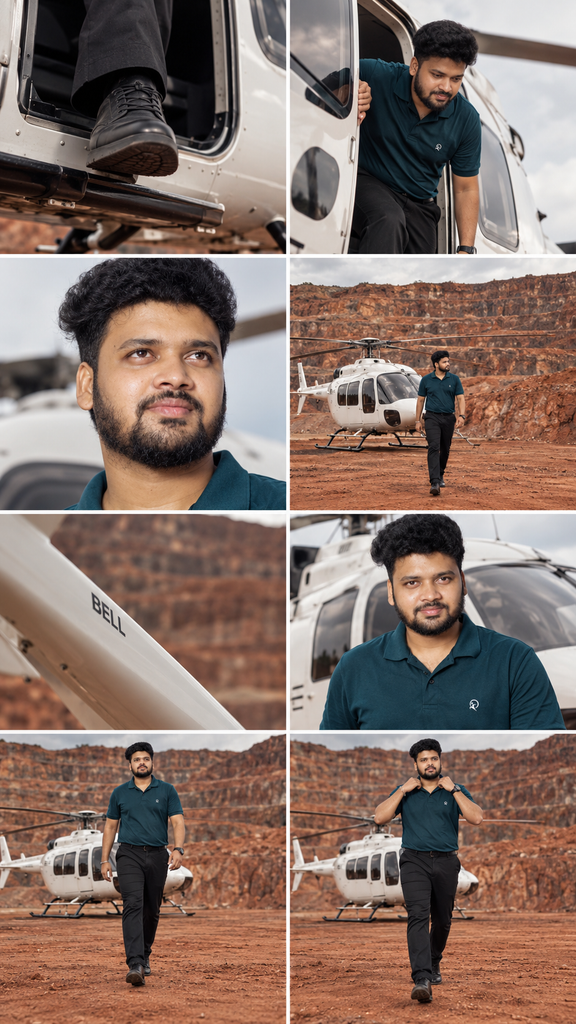
REFERENCE IMAGE 2 — MASTER SCENE / STORYBOARD REFERENCE

Use Image 2 as the EXACT visual composition, scene, camera, framing, pose, environment and cinematic-style reference.


Create a highly realistic cinematic vertical 9:16 image that recreates the visual sequence shown in Image 2 as accurately as possible.


IMPORTANT:

Do NOT redesign the character.

Do NOT create a different person.

Preserve the exact facial identity from Image 1, including:

exact face shape, facial proportions, eyes, eyebrows, nose, lips, jawline, beard, hairstyle, hairline, skin tone, age appearance and recognizable facial features.


Preserve the exact clothing and accessories from Image 1:

teal shirt, black trousers, wristwatch, bracelet and all visible accessories.

Keep realistic fabric texture and natural clothing folds.


MASTER SCENE:

A large reddish-brown open quarry with dramatic layered/terraced rocky terrain under a pale cloudy sky.

A realistic white helicopter is parked in the quarry with its side doorway open.


RECREATE THE STORYBOARD SHOTS EXACTLY IN THIS VISUAL ORDER:


SHOT 1 — 0.00–1.90s:

EXTREME TIGHT CLOSE-UP.

Show only the character's lower leg and dark shoe stepping outward through the open side doorway of the white helicopter.

Camera extremely close to the helicopter doorway and positioned very low.

Tight vertical composition.

Realistic shoe, trouser fabric and helicopter doorway details.

Slow controlled cinematic movement feeling.


SHOT 2 — 1.90–3.70s:

CLOSE SIDE SHOT.

The exact same character is emerging from the helicopter doorway.

One hand firmly grips the helicopter doorway/frame.

Upper body leans outward.

Head slightly lowered.

White helicopter dominates the surrounding frame.

Low-angle cinematic perspective.


SHOT 3 — 3.70–5.10s:

EXTREME CLOSE-UP PORTRAIT.

Show the character's exact face from Image 1.

Serious, calm, composed expression.

No smile.

Head and chin slightly raised.

Eyes looking slightly upward/forward.

Pale sky and a softly blurred portion of the helicopter in the background.

Very shallow depth of field.

Highly realistic skin and facial texture.


SHOT 4 — 5.10–6.50s:

WIDE ESTABLISHING SHOT.

Reveal the complete white helicopter parked in the huge reddish-brown quarry.

The character stands beside the helicopter and begins walking away from it.

Show layered quarry cliffs/terraced earth formations.

Pale cloudy sky.

Warm natural earthy tones.

Character remains clearly recognizable.


SHOT 5 — 6.50–7.50s:

EXTREME CLOSE-UP OF HELICOPTER STRUCTURE.

A pale white helicopter structural element crosses the frame diagonally, matching the reference composition.

Keep the quarry softly blurred in the background.

Do not add unnecessary mechanical components.


SHOT 6 — 7.50–8.70s:

MEDIUM CLOSE-UP.

Character stands beside the white helicopter.

Face toward camera.

Serious, controlled expression.

Helicopter clearly visible behind him.

Chest/eye-level camera.

Cinematic shallow depth of field.

Natural outdoor lighting.


SHOT 7 — 8.70–9.45s:

WIDER FULL-BODY SHOT.

Character walks directly toward the camera across the reddish quarry terrain.

Upright confident posture.

Natural arm movement.

One foot naturally forward.

Realistic walking stance and foot placement.

Helicopter remains visible behind him.


SHOT 8 — 9.45–10.00s:

MEDIUM/FULL-BODY CINEMATIC SHOT.

Continue the exact forward movement.

Character begins raising BOTH hands toward his shirt collar.

Hands are just beginning to reach the collar.

Serious, stylish cinematic expression.

This must look like the exact continuation of Shot 7.


FINAL CONTINUITY:

The final frame must end with the character moving forward while both hands are beginning to rise toward his collar.

Do not reset his body position.

Do not change his face.

Do not change his clothing.

Do not change the environment.


VISUAL STYLE:

Photorealistic cinematic action-film photography.

Ultra-realistic human anatomy.

Natural skin pores and facial texture.

Realistic teal fabric.

Realistic black trousers.

Realistic white helicopter materials.

Natural outdoor lighting.

Subtle atmospheric dust.

Cinematic depth of field.

Natural motion-blur feeling.

High dynamic range.

Professional action-film cinematography.

Realistic perspective.

High detail.

Sharp character face.

Vertical 9:16 composition.

4K/8K quality.


STRICT NEGATIVE PROMPT:

different person, identity change, face change, face morphing, facial distortion, altered facial structure, different eyes, different nose, different lips, different jawline, different beard, different hairstyle, different hairline, skin tone change, age change, body proportion change, body shape change, clothing change, different shirt, different shirt color, missing wristwatch, missing bracelet, accessory change, duplicate character, extra person, extra limbs, extra fingers, fused fingers, malformed hands, malformed feet, distorted body, unnatural walking, sliding feet, floating feet, robotic movement, CGI, cartoon, anime, illustration, plastic skin, fake face, blurry face, low detail, over-smoothed skin, excessive sharpening, fake expression, smile, background replacement, different helicopter, extra helicopter, helicopter deformation, changing quarry, random objects, random camera angle, random zoom, random rotation, excessive camera shake, flickering, temporal inconsistency, incorrect shot order, incorrect pose, incorrect framing, unrealistic perspective.


ABSOLUTE REFERENCE PRIORITY:

Image 1 = EXACT CHARACTER IDENTITY.

Image 2 = EXACT SCENE, COMPOSITION, POSE, CAMERA AND VISUAL REFERENCE.


Do not reinterpret the reference.

Do not redesign anything.

Match the reference as closely as possible while replacing the reference character with the exact person from Image 1.
Video prompt…
Create the FIRST 10 SECONDS of the uploaded reference video as accurately as possible.


Use the uploaded image as the PRIMARY CHARACTER IDENTITY REFERENCE. Preserve the exact face, facial features, hairstyle, skin tone, body proportions, teal shirt, black trousers, wristwatch and all visible accessories. Do not change or redesign the person.


Use the uploaded reference video as the EXACT motion, camera, framing, timing and visual-style reference.


0.00–1.90 seconds:

Start with an extremely tight cinematic close-up of the helicopter doorway/lower doorway area. A man's lower leg and dark shoe move outward through the open side doorway of a white helicopter. Keep the camera very close and low. Preserve the tight vertical 9:16 composition and slow controlled movement.


1.90–3.70 seconds:

Hard cut to the side of the white helicopter. The main character emerges from the open doorway. One hand holds/grips the helicopter doorway while his upper body leans outward. His head is initially slightly lowered. Camera remains close to the helicopter with a slightly low-angle perspective.


3.70–5.10 seconds:

Hard cut to an extreme close-up of the character's face. Use the uploaded person's exact face and identity. He has a serious, composed expression and looks slightly upward/forward. Do not make him smile. Keep the pale sky and part of the helicopter softly visible behind him. Use shallow depth of field.


5.10–6.50 seconds:

Hard cut to a wide establishing shot. Reveal the white helicopter on a large reddish-brown open quarry landscape with layered/terraced earth formations. The main character is beside the helicopter and begins moving away from it. Preserve the pale sky, warm earthy tones and cinematic atmosphere.


6.50–7.50 seconds:

Hard cut to a close-up of the helicopter exterior/structural area. A pale helicopter structural element crosses the frame diagonally. Reproduce the visible movement and perspective change from the reference. Do not invent unnecessary mechanical details.


7.50–8.70 seconds:

Hard cut back to a medium close-up of the character beside the helicopter. He faces toward camera with a serious, controlled expression. Keep the helicopter visible behind him. Camera is approximately chest/eye level with cinematic shallow depth of field.


8.70–9.45 seconds:

Cut to a wider/full-body shot. The character walks toward the camera across the reddish quarry terrain. Maintain upright posture, natural arm movement, realistic foot placement and steady walking speed.


9.45–10.00 seconds:

Continue the forward movement and begin the next action naturally: the character starts bringing both hands upward toward his shirt collar. End the video with his hands beginning to reach the collar so the next 10-second clip can continue from this exact physical position.


VISUAL STYLE:

Photorealistic cinematic action-film footage, realistic human anatomy, realistic skin and fabric, natural outdoor lighting, subtle cinematic motion blur, realistic depth of field, high detail, 30fps-style smooth motion, vertical 9:16.


NEGATIVE PROMPT:

face change, identity change, different person, face morphing, facial distortion, hairstyle change, hairline change, beard change, skin tone change, age change, body distortion, body proportion change, clothing change, teal shirt changing color, black trousers changing, missing wristwatch, accessory change, duplicate character, extra characters, unwanted objects, extra helicopter, changing helicopter, changing quarry, background replacement, extra limbs, extra fingers, fused fingers, malformed hands, malformed feet, unnatural walking, sliding feet, floating body, robotic movement, fake expression, exaggerated smile, flickering, morphing, temporal inconsistency, background flicker, camera glitch, random zoom, random orbit, random rotation, excessive camera shake, sudden scene change, wrong shot order, wrong timing, low quality, blurry face, plastic skin, CGI appearance, cartoon, anime, unrealistic physics.


ABSOLUTE CONTINUITY LOCK:

The uploaded image controls the character's exact identity and appearance.

The uploaded video controls the motion, timing, camera movement, framing and visual dynamics.

Keep the exact same face, hairstyle, skin tone, teal shirt, black trousers, wristwatch and body proportions throughout.

End exactly with the character moving forward and both hands beginning to rise toward his collar. The next clip must begin from this exact ending pose, position and motion without resetting the character