
 Saiteja

Credit card minimum due is the smallest amount you must pay to avoid a late fee, but paying only this amount is one of the costliest money mistakes.
Paying only the minimum amount due on your credit card feels easy, but it is one of the most expensive money mistakes. Here is how the minimum due trap works and how to get out of it.
Table of Contents
What Is Minimum Amount Due?
The minimum due is usually around 5% of your total bill. If you pay it by the due date, you avoid the late payment fee. But the rest of the bill is carried forward with heavy interest.
How Much Interest Do You Pay?
| Item | Typical value |
|---|---|
| Interest per month | About 3% – 3.75% |
| Interest per year | Around 36% – 45% |
| Interest-free period | Lost if full bill is not paid |
Rates vary by bank and card, so check your card’s MITC (Most Important Terms and Conditions).
The Hidden Problem: Interest-Free Period Is Gone
- Interest is charged on the unpaid balance
- Interest is usually calculated from the purchase date
- New purchases also start attracting interest until the full balance is cleared
Example
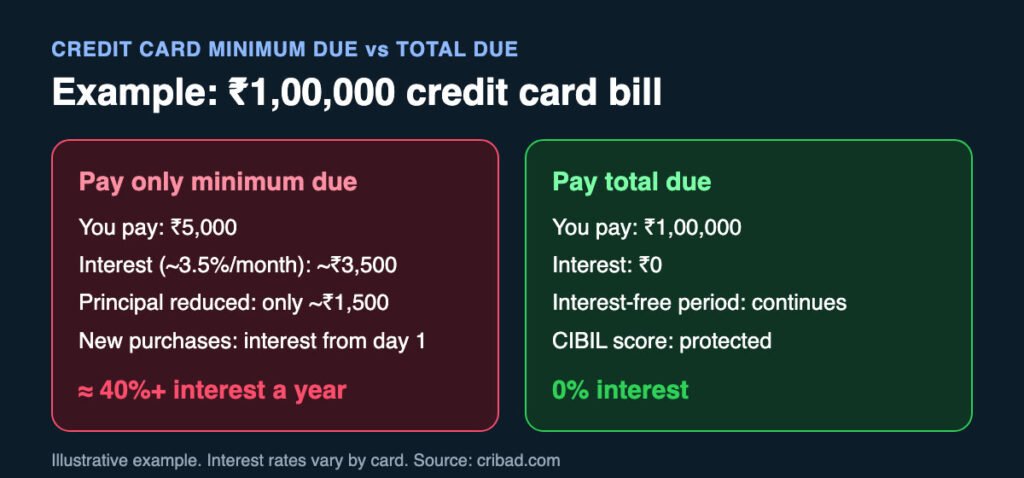
Suppose your bill is ₹1,00,000 and you pay the minimum due of ₹5,000. At about 3.5% per month, around ₹3,500 goes towards interest, and your actual outstanding reduces by only about ₹1,500. At this speed, clearing the debt can take years.
How to Avoid the Minimum Due Trap
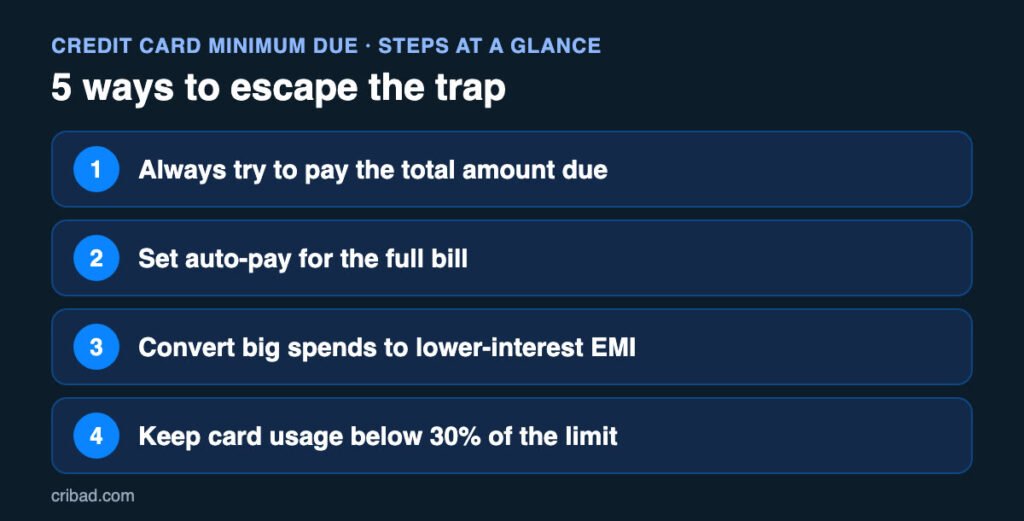
- Always pay the total amount due by the due date
- Set up auto-pay for the full amount
- If you cannot pay in full, ask your bank to convert the amount into EMI, which usually has a lower interest rate than revolving credit
- Avoid new purchases on the card until the balance is cleared
- Use less than 30% of your credit limit
5 Facts About Credit Card Minimum Due
- The credit card minimum due is usually around 5% of the total bill
- Interest of about 3 to 3.75% per month is charged on the unpaid balance
- That is roughly 36 to 45% interest per year
- New purchases also start attracting interest from day one
- Paying only the minimum can take years to clear even a small bill
Credit Card Minimum Due vs Total Due
The total amount due is your full bill. If you pay the total due by the due date, you pay zero interest. If you pay only the credit card minimum due, the bank charges interest on the remaining amount and also on new purchases.
- Pay total due: no interest, interest-free period continues
- Pay minimum due: no late fee, but high interest
- Pay less than minimum due: late fee plus interest plus impact on CIBIL
5 Easy Ways to Escape the Minimum Due Trap
- Set up auto-pay for the total amount due
- Convert big purchases into EMI, which usually has a lower rate
- Use a balance transfer to a card with a lower rate, if available
- Clear the highest-interest card first
- Keep card usage below 30% of the limit so the bill stays manageable
Watch the Video
A Simple Monthly Plan to Clear Credit Card Debt
If you already have a large outstanding amount on your card, do not panic. A clear plan can help you come out of debt in a few months.

- Stop using the card for new purchases until the balance is cleared
- List all your cards with outstanding amount and interest rate
- Pay the full minimum on every card so there is no late fee
- Put every extra rupee on the card with the highest interest rate
- Once that card is cleared, move to the next one
This method is often called the avalanche method. It saves the most money because you attack the most expensive debt first. Some people prefer to clear the smallest balance first for motivation. Both work, as long as you stay consistent.
You can also ask your bank about converting the outstanding amount into an EMI plan. EMI interest is usually lower than the regular card interest, and the fixed monthly payment makes budgeting easier. Read the processing fee and foreclosure terms before you accept.
Another option is a personal loan at a lower rate to close the card debt completely. This makes sense only if the loan interest is clearly lower and you do not start using the card again.
Finally, after the debt is cleared, keep the card but use it only for planned expenses that you can pay in full every month.
Frequently Asked Questions
Does paying minimum due affect my CIBIL score?
Paying the minimum on time avoids a late payment mark, but high outstanding balances increase your credit utilisation, which can lower your score.
Is EMI conversion always cheaper?
Usually it is cheaper than revolving interest, but check the interest rate and processing fee before converting.
Is paying credit card minimum due bad for my credit score?
Paying the minimum due on time avoids a late payment mark, but a high outstanding balance raises your credit utilisation, which can lower your score.

How is credit card minimum due calculated?
Most banks take a small percentage of the total outstanding plus any EMI, fees and overdue amount. Check your card statement for the exact formula.
Related Guides
- Lost Money in Online Fraud? Call 1930 in the Golden Hour (Complete Guide)
- How to Check Fake Loans Taken on Your PAN Card for Free
- Phone Lost? Block UPI, SIM and IMEI in 10 Minutes (Complete Guide)
Official source: RBI credit card guidelines. Always verify the latest rules on the official website.
Conclusion
Minimum due is a safety net, not a payment plan. Pay the full bill every month and your credit card stays a useful tool instead of a costly loan.
Disclaimer: This article is for information purposes only and is not financial advice. Interest rates and charges vary by bank. Check your card terms for exact details.