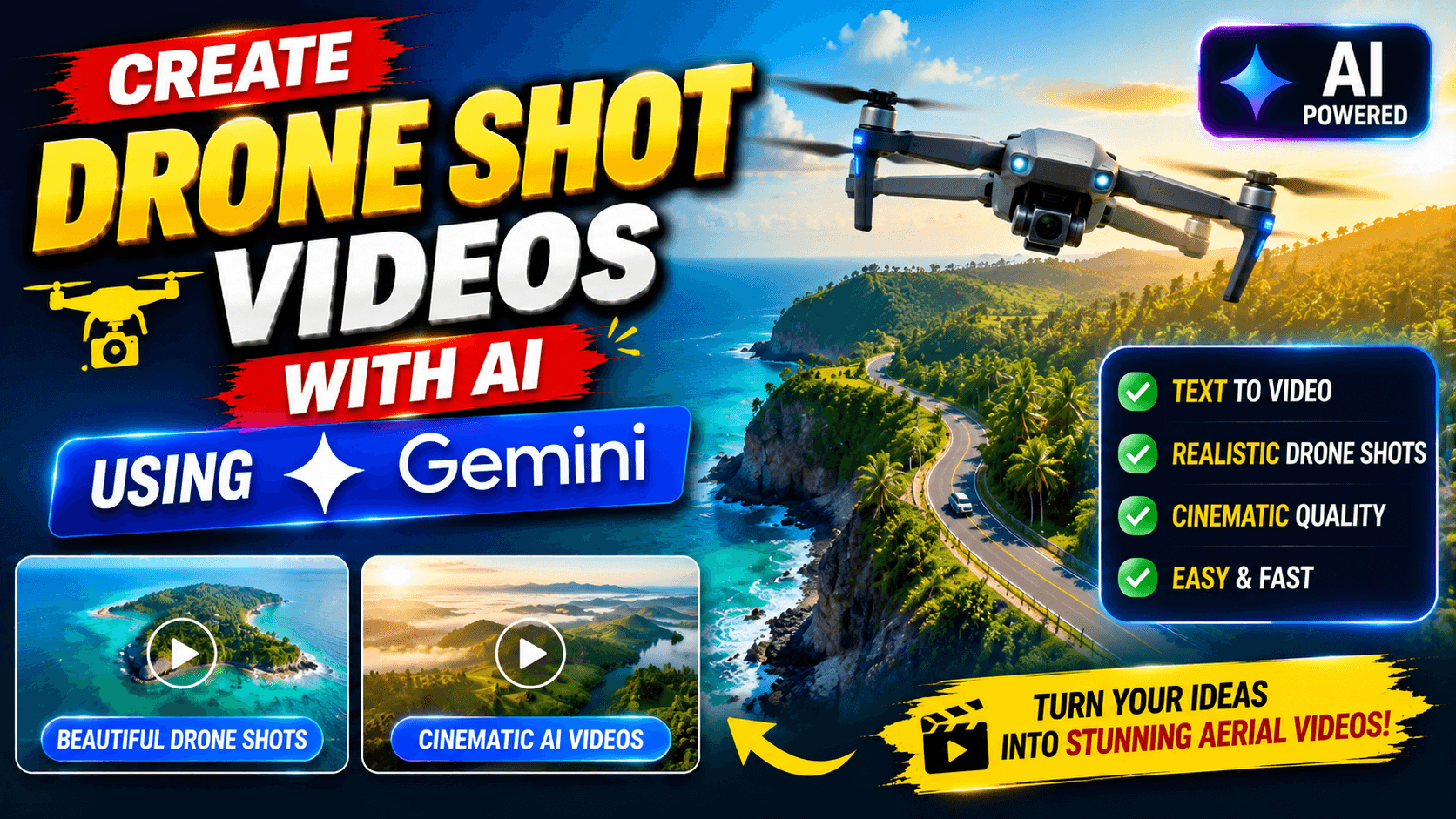
Create Drone Shot Videos with AI Using Gemini – Artificial intelligence has completely changed the way creators produce videos. Until recently, capturing breathtaking aerial footage required an expensive drone, professional flying skills, and ideal weather conditions. Today, Gemini AI makes it possible to create realistic drone shot videos from a single image. By combining advanced image understanding with Google’s latest AI video generation technology, users can transform ordinary photos into cinematic aerial sequences within minutes. Google recently expanded Gemini’s video creation capabilities with Gemini Omni, allowing users to generate and edit videos using text prompts, images, and even existing videos.
Whether you’re a content creator, YouTuber, digital marketer, or social media enthusiast, AI-generated drone videos can dramatically improve your content quality without requiring expensive equipment. These videos simulate smooth aerial movement, realistic camera angles, natural depth, and cinematic transitions that closely resemble professional drone footage. Because platforms like Instagram Reels, YouTube Shorts, and TikTok prioritize visually engaging content, AI drone shots have quickly become one of the biggest trends in content creation. This guide explains everything you need to know—from choosing the perfect image to writing effective prompts and generating professional-looking drone videos using Gemini AI.
What Is an AI Drone Shot?
An AI drone shot is a video created using artificial intelligence that simulates the movement and perspective of a real drone camera. Instead of physically flying a drone, AI analyzes a still image or a text description and generates smooth cinematic motion that looks like it was captured from the sky. Modern AI models understand depth, perspective, lighting, shadows, and object positioning, allowing them to create convincing aerial movements even though the original image was completely static. This technology has become increasingly popular because it removes the barriers associated with traditional drone filming, such as purchasing expensive equipment, obtaining flight permissions, dealing with weather conditions, and learning complex flying skills.
The biggest advantage of AI drone videos is accessibility. Anyone with a smartphone or computer can now create professional-looking cinematic content in just a few minutes. Businesses use AI drone shots for product promotions, real estate showcases, travel advertisements, and social media campaigns. Influencers transform ordinary selfies into dramatic cinematic reveals, while photographers add motion to landscape images that previously remained static. AI also allows creators to experiment with impossible camera movements that would be difficult—or even dangerous—to achieve using a real drone. As generative AI continues to evolve, the realism of these videos is improving rapidly, making them almost indistinguishable from professionally captured aerial footage in many situations.
Prompt and Process:
Step 1: Draw the Guides
On your base image, draw two specific color-coded guides. These are production guides only and will be erased by Gemini before the animation begins.
- Red Line (Flight Path): Trace the drone’s route as a single line, capturing its curves, direction of travel, and endpoint.
Step Two: Generate in Gemini
- Open Google Gemini and select the Video model.
- Upload your image.
- Copy and paste the exact prompt provided below into the model.
Use the attached image as the starting frame. The red line represents the drone flight waypoints and trajectory only, while the white arrows represent the camera viewing direction only. These are production guides, not scene elements, and must never appear in the final animation. Remove all guides before the animation begins and reveal the clean underlying image.

Create a single continuous aerial drone POV that flies along the exact path defined by the red waypoint line, matching its route, curves, movement direction, and endpoint as closely as possible.

Throughout the entire flight, orient the camera according to the white directional arrows, ensuring the drone follows the red path while the camera continuously looks where the white arrows indicate, naturally keeping the subject framed at all times.

The drone trajectory and camera orientation are the highest-priority instructions and must be followed exactly, even when the movement path and viewing direction differ. Use smooth, cinematic drone motion with realistic inertia, gentle banking, and natural acceleration and deceleration, with no cuts, teleports, or sudden camera swings.

Preserve the original scene exactly as shown without modifying the environment, lighting, subject, composition, or any objects. The only change should be the realistic drone movement following the red waypoint path while the camera continuously follows the white viewing directions.

Produce clean, photorealistic footage with no visible guides, annotations, arrows, lines, overlays, graphics, text, or watermarks in any frame.
Why AI Drone Videos Are Trending
AI-generated drone videos have exploded in popularity because they perfectly match today’s short-form content landscape. Platforms like Instagram Reels, TikTok, YouTube Shorts, and Facebook Reels reward visually engaging videos that immediately grab viewers’ attention. A dramatic aerial movement during the first few seconds of a video can significantly improve watch time, increase audience retention, and encourage viewers to share the content. Since engagement signals play a major role in social media algorithms, creators are constantly looking for innovative visual styles that stand out from ordinary videos.
Another major factor behind this trend is affordability. Purchasing a quality drone, replacing damaged parts, maintaining batteries, obtaining insurance, and complying with aviation regulations can cost hundreds or even thousands of dollars. AI removes nearly all of these expenses. Instead of investing in hardware, users simply upload a high-quality image and provide a well-written prompt. The AI handles the rest. This democratization of cinematic content creation allows small creators, students, freelancers, and businesses with limited budgets to produce premium-quality visuals that compete with much larger production teams. As AI continues to improve, creators who master prompt writing and creative storytelling will have an enormous advantage over those relying solely on traditional filming methods.
How Gemini Creates Drone-Style Videos
Gemini uses advanced multimodal artificial intelligence to understand both images and natural language prompts. When you upload a photograph, the AI identifies important visual elements such as people, buildings, trees, roads, mountains, skies, reflections, and lighting conditions. It also estimates depth, perspective, and object relationships, enabling it to predict how a camera would naturally move through the scene. Once you enter a detailed prompt describing the desired drone movement, Gemini combines image understanding with video generation technology to animate the scene while maintaining realistic lighting and object consistency.
Unlike traditional animation software that requires manual keyframes and editing skills, Gemini automatically generates smooth camera paths using AI reasoning. For example, if your prompt requests a slow cinematic drone pull-back with a slight upward movement during golden hour, Gemini attempts to recreate that motion while preserving realistic environmental details. The quality of the final video largely depends on the clarity of your prompt and the quality of the uploaded image. Images with good lighting, sharp details, and clear subjects generally produce the most convincing drone videos. Because Gemini continues to receive frequent improvements from Google, its ability to generate natural camera movements, realistic environmental effects, and cinematic transitions is becoming increasingly sophisticated, making it one of the most promising AI video creation tools available today.
What You Need Before Getting Started
Creating an impressive AI drone video begins long before pressing the Generate button. Preparation plays a significant role in determining the final quality of the video. Many beginners assume that AI can magically transform any low-resolution image into a cinematic masterpiece, but the reality is that high-quality input almost always leads to better output. Before starting, ensure you have access to Gemini’s latest video generation features, a stable internet connection, and a suitable reference image with good composition. Spending a few extra minutes preparing your materials can dramatically improve the realism of your final result.
You should also think about the story you want your drone shot to tell. Are you showcasing a travel destination, highlighting a luxury property, introducing a product, or creating an emotional cinematic portrait? Different goals require different camera movements and prompt styles. Planning your desired outcome in advance allows you to write more detailed prompts that produce better results. Remember that AI works best when given clear creative direction rather than vague instructions. The combination of a high-quality image, a well-defined concept, and a detailed prompt forms the foundation of every successful AI drone video.
Gemini AI Subscription Requirements
While Gemini offers many AI capabilities for free, some of its advanced video generation features may require access to premium plans such as Google AI Pro or Google AI Ultra, depending on your region and Google’s latest feature rollout. These plans generally provide higher usage limits, faster processing, access to newer AI models, and experimental creative tools. Google frequently updates feature availability, so users should check the latest subscription information within the Gemini interface before beginning a project.
Premium access is especially valuable for content creators who regularly generate AI videos because it often includes higher-quality outputs and shorter waiting times. Businesses producing marketing content may also benefit from these plans because consistent access helps streamline production workflows. Even if you begin with a free plan, learning prompt engineering and understanding how Gemini interprets images will prepare you for more advanced features as they become available. The AI landscape changes rapidly, and staying updated ensures that you always take advantage of the latest improvements in Google’s video generation technology.
Choosing the Best Reference Image
The quality of your AI-generated drone video depends heavily on the reference image you upload. Think of the image as the foundation of a building—if the foundation is strong, everything built on top of it becomes more stable and visually appealing. Gemini can generate impressive cinematic motion, but it cannot completely compensate for blurry, poorly lit, or cluttered images. A high-resolution photo with good lighting, sharp details, and a clearly visible subject gives the AI enough visual information to create realistic camera movement. Portraits taken during the golden hour, landscape photos with visible depth, and travel images with mountains, beaches, lakes, or city skylines often produce the most cinematic results.
Composition is equally important. Images that naturally contain foreground, middle-ground, and background elements help Gemini estimate depth more accurately. For example, a person standing on a hill with mountains in the distance gives the AI multiple visual layers to animate, making the drone movement feel authentic. If your subject occupies the entire frame without any surrounding environment, the generated movement may appear limited because the AI has less contextual information to work with. It is also advisable to avoid heavily filtered photos, excessive blur, or extreme shadows, as these can confuse the AI and reduce realism. Spending time selecting the right image is one of the easiest ways to improve your final video without changing anything else.
Step-by-Step Guide to Create AI Drone Videos
Creating an AI drone video in Gemini is surprisingly simple once you understand the workflow. Instead of learning complicated editing software or operating an actual drone, you only need an image and a carefully written prompt. Each step builds upon the previous one, so following the process carefully helps produce better cinematic results. Beginners often rush through prompt writing, but experienced creators know that the prompt is where the real creativity begins. A detailed prompt gives Gemini clear instructions about camera movement, lighting, mood, speed, and visual style.
The following steps explain exactly how to transform an ordinary photograph into a professional-looking drone shot. Although Google continues updating Gemini with new capabilities, the overall workflow remains largely the same. Understanding these fundamentals will also make it easier to use future AI video generation features as they become available.
Step 1: Open Gemini
Start by opening Gemini on your web browser or mobile application and sign in using your Google account. Make sure your account has access to AI video generation features. If video generation is available for your region and subscription, you’ll see options for creating videos using text prompts or image uploads. Since Google regularly introduces new experimental features, the interface may change slightly over time, but the core functionality remains straightforward.
Before uploading anything, take a moment to familiarize yourself with the available settings. Some versions of Gemini allow users to choose video duration, aspect ratio, generation quality, or creative style. These options can significantly influence the final output. If you’re creating content for Instagram Reels or YouTube Shorts, consider selecting a vertical aspect ratio. For YouTube videos or cinematic presentations, a horizontal format may work better. Starting with the correct settings saves time later and ensures your video matches the platform where it will be published.
Step 2: Upload Your Photo
Once you’re inside the video generation workspace, upload your chosen reference image. Gemini will analyze the photo to understand the scene, identify subjects, estimate depth, and recognize important visual details. This analysis forms the basis for the AI’s understanding of how the camera should move through the environment. Uploading a high-quality image minimizes visual artifacts and improves the overall realism of the generated animation.
After the upload is complete, inspect the preview carefully. Ensure that the subject is clearly visible and that no important parts of the image have been cropped unintentionally. If your image contains distracting objects, poor lighting, or excessive background clutter, consider replacing it with a better version before continuing. A cleaner image allows Gemini to focus on the primary subject while generating smoother camera motion. Professional creators often test multiple images before selecting the one that produces the strongest cinematic effect.
Step 3: Enter a Cinematic Drone Prompt
The prompt is the heart of your AI drone video. It tells Gemini exactly how the virtual camera should behave. Instead of writing something generic like “make a drone video,” describe the camera movement, lighting, atmosphere, subject, speed, and cinematic style in detail. The more descriptive your prompt, the better Gemini can interpret your creative vision. Imagine you’re directing a professional drone operator and explaining every movement before filming begins.
Good prompts also include environmental details such as golden-hour lighting, soft clouds, realistic shadows, gentle wind, cinematic color grading, or slow-motion effects. These small additions dramatically improve the quality of the generated video because they provide the AI with richer creative context. Avoid contradictory instructions, such as requesting both fast action and slow cinematic movement simultaneously, as conflicting directions may confuse the AI and produce inconsistent results.
Best Drone Camera Prompt Example
Create a realistic cinematic drone shot starting with a close-up of the subject and slowly pulling backward while smoothly rising into the sky. Maintain natural lighting, realistic shadows, detailed textures, soft camera stabilization, and cinematic color grading. Add subtle wind movement to trees and clothing, realistic depth, gentle cloud motion, and smooth aerial transitions. The video should feel like it was captured using a professional 4K drone with slow, elegant camera movement and highly realistic environmental details.You can further customize this prompt depending on your content:
- Travel Videos: Include beaches, waterfalls, mountains, or city skylines.
- Real Estate: Focus on revealing the entire property with smooth aerial movement.
- Portraits: Begin with a close-up before slowly pulling away to reveal the surrounding environment.
- Nature: Emphasize forests, rivers, wildlife, and atmospheric lighting.
Step 4: Generate the Video
After entering your prompt, click the Generate button and allow Gemini to process the request. Depending on server demand, internet speed, and the complexity of your prompt, generation may take anywhere from a few seconds to several minutes. During this stage, Gemini analyzes your image, interprets the prompt, predicts realistic camera movement, and renders the final animation. Although the waiting time may vary, the process is significantly faster than traditional video production methods.
Once the video is ready, watch it carefully from beginning to end. Pay attention to camera smoothness, subject consistency, lighting, and any unexpected visual artifacts. AI generation is rarely perfect on the first attempt. Small refinements to the prompt—such as slowing down the camera movement or adding more environmental detail—can dramatically improve the final result. Professional AI creators often generate multiple versions before selecting the best one for publication.
Step 5: Edit and Improve the Result
Even an excellent AI-generated drone shot can benefit from light editing. Import the generated video into editing software such as CapCut, Adobe Premiere Pro, DaVinci Resolve, or another preferred editor. Basic adjustments like color correction, sharpening, contrast enhancement, cinematic LUTs, background music, and subtle sound effects can elevate the overall quality. Adding gentle drone sound effects or ambient nature audio also increases realism and creates a more immersive viewing experience.
Don’t be afraid to experiment with multiple AI generations. Sometimes a slight change in wording—such as replacing “fly upward” with “slow cinematic ascending pull-back”—can produce a dramatically different result. Save your best prompts in a document so you can reuse and improve them for future projects. As you gain experience, you’ll develop a personal library of prompt templates tailored to travel, real estate, portraits, product videos, and social media content. This workflow not only improves efficiency but also helps maintain a consistent visual style across all your AI-generated videos.
Common Mistakes to Avoid
Creating AI drone videos with Gemini is easier than ever, but many beginners unknowingly make mistakes that reduce the quality of their final output. The biggest misconception is believing that AI can automatically fix every problem in a poor-quality image. While Gemini is incredibly powerful, it performs best when it receives clear, high-quality input and well-structured instructions. Understanding the most common mistakes can save you hours of trial and error while helping you produce professional-looking cinematic videos from the very first attempt. Small improvements in your workflow can often make a much bigger difference than changing AI models or using expensive editing software.
One of the most common mistakes is using low-resolution or blurry images. Since the AI relies on image details to estimate depth and generate movement, poor-quality photos often result in unrealistic animations, distorted backgrounds, or flickering objects. Another frequent error is writing prompts that are too short or too vague. Instructions such as “make a drone video” don’t provide enough creative direction for the AI. Instead, describe the camera movement, speed, lighting, atmosphere, environment, and cinematic style in detail. Avoid combining multiple conflicting instructions in the same prompt, such as asking for both “fast action” and “slow cinematic movement,” because the AI may struggle to balance contradictory requests.
Creators also tend to over-edit the final video. Excessive sharpening, saturated colors, aggressive filters, or unrealistic transitions can make an otherwise impressive AI-generated clip look artificial. Maintaining a natural appearance usually produces more professional results. Another mistake is ignoring aspect ratio requirements. A vertical video works best for Instagram Reels, TikTok, and YouTube Shorts, while horizontal footage is more suitable for YouTube videos and presentations. Finally, many users generate only one version and immediately publish it. Experienced AI creators often create multiple variations, compare them carefully, adjust their prompts, and combine the best results. This iterative process consistently produces higher-quality content and allows you to discover creative camera movements that may not appear during the first generation.
Conclusion
Artificial intelligence has fundamentally changed the way cinematic content is created, and Gemini has become one of the most exciting tools available for generating realistic drone-style videos without using an actual drone. By combining advanced image analysis with powerful AI video generation, Gemini allows creators to transform ordinary photographs into dynamic aerial sequences that capture attention across social media platforms. Whether you are producing travel videos, promoting real estate, showcasing products, or creating engaging personal content, AI-generated drone shots provide a fast, affordable, and highly creative alternative to traditional drone filming.
The key to achieving professional-quality results lies in preparation and experimentation. Choosing a high-resolution image, writing a detailed cinematic prompt, selecting appropriate camera movements, and refining the generated output through light editing all contribute to creating realistic and visually stunning videos. As Google’s AI technology continues to evolve, Gemini is expected to deliver even better motion consistency, improved realism, longer video generation capabilities, and more advanced editing features. Creators who invest time in learning prompt engineering today will be well-positioned to take advantage of future AI innovations.
Instead of viewing AI as a replacement for creativity, think of it as a creative partner. The technology handles the complex technical work, while you remain responsible for storytelling, visual direction, and artistic vision. By combining thoughtful planning with Gemini’s growing capabilities, anyone can produce cinematic drone videos that were once possible only with expensive equipment and professional production teams. The future of video creation is becoming more accessible every day, and AI drone videos represent just the beginning of what’s possible.
Frequently Asked Questions (FAQs)
1. Can I create AI drone videos in Gemini for free?
Gemini offers several AI features at no cost, but advanced video generation capabilities may require a Google AI Pro or Google AI Ultra subscription depending on your country and Google’s latest feature availability. Check your Gemini account to see which features are currently available.
2. What type of image produces the best AI drone video?
High-resolution images with sharp details, balanced lighting, and a clear foreground, middle ground, and background generally produce the most realistic results. Landscape, travel, portrait, and real estate photos usually work exceptionally well.
3. How can I make my AI drone videos look more realistic?
Use detailed prompts describing smooth cinematic camera movement, natural lighting, realistic shadows, subtle environmental motion, and professional color grading. After generation, perform light color correction and add ambient audio for an even more immersive result.
4. Can I upload my own selfie and create a drone shot?
Yes. Gemini can animate personal photographs into cinematic drone-style videos. For the best results, use a high-quality image where the subject is clearly visible and the surrounding environment provides enough visual depth for realistic camera movement.
5. Are AI-generated drone videos suitable for YouTube and Instagram?
Absolutely. AI drone videos are ideal for YouTube Shorts, Instagram Reels, TikTok, and Facebook Reels. Simply generate the video in the appropriate aspect ratio and perform basic editing before publishing to maximize engagement.